


Solar Generator for Home: Sizing and Setup Guide
Table of Contents
- What a Solar Generator for Home Backup Actually Powers
- How to Calculate Home Energy Consumption Before You Buy
- Solar Generator Battery Capacity Explained: Watt-Hours and Depth of Discharge
- Portable Power Station vs Solar Generator: What's the Real Difference?
- Step-by-Step: Wiring a Solar Generator Into Your Home Electrical Panel
- Real-World Runtime: How Long Your Solar Generator for Home Will Last
- Common Mistakes When Sizing a Solar Generator for Home Use
- Frequently Asked Questions
Last Updated: September 24, 2026
What a Solar Generator for Home Backup Actually Powers
A solar generator for home backup stores energy from photovoltaic panels and delivers it through standard AC outlets during an outage. Unlike a gas generator, it produces no exhaust and needs no fuel. Homeowners routinely overestimate what one unit can run and underestimate what a refrigerator, well pump, or furnace blower draws at startup.
A typical solar generator can reliably run:
- Refrigerator and freezer (cycling, not continuous)
- LED lighting and phone or laptop charging
- Internet router and modem
- CPAP machine or small medical devices
- Sump pump (if sized correctly)
How to Calculate Home Energy Consumption Before You Buy
Start with the devices you cannot live without during an outage, then add their wattage. Most buyers skip this step, and it's why systems get returned.
How to calculate home energy consumption for backup sizing:
- List every device you want to run during an outage
- Find each device's wattage on its label or manual
- Estimate daily hours of use per device
- Multiply watts × hours to get watt-hours per day
- Add 20-30% headroom for surge and inefficiency
- Match that total to your battery's usable capacity
Solar Generator Battery Capacity Explained: Watt-Hours and Depth of Discharge
Battery capacity on a solar generator is measured in watt-hours or kilowatt-hours, and usable capacity is always less than rated. That difference is depth of discharge, and it determines runtime.
| Battery Chemistry | Typical DoD | Charge Cycles | Best For |
|---|---|---|---|
| LiFePO4 | 80-90% | 3,000-5,000+ | Daily use, long-term backup |
| Lithium-ion (NMC) | 70-80% | 500-1,000 | Light portable use |
| Lead-acid | 50% | 300-500 | Budget, stationary setups |
Portable Power Station vs Solar Generator: What's the Real Difference?
The terms get used interchangeably, but they differ. A portable power station is a battery and inverter in a case. A solar generator is that unit paired with solar input capability, often sold as a kit with panels.
The practical difference shows up in three areas:
- Solar input rating: Measured in watts, this caps how fast panels can refill the battery
- Charge controller type: MPPT controllers harvest more from panels than PWM, especially in low light
- Expandability: Some units accept additional batteries; others are sealed
Step-by-Step: Wiring a Solar Generator Into Your Home Electrical Panel
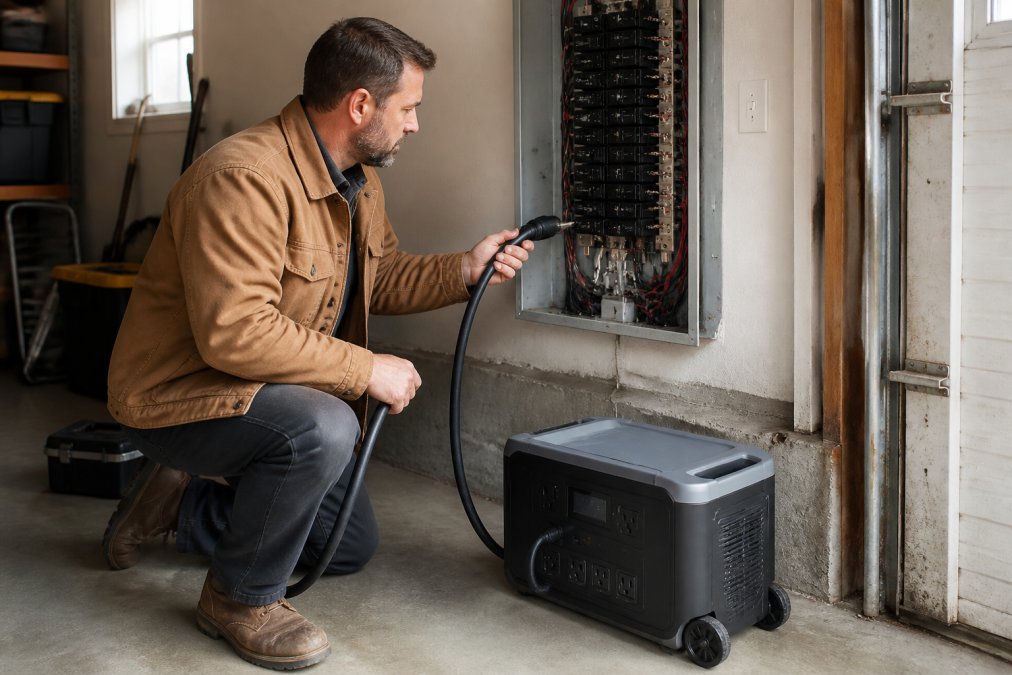
Connecting a solar generator to your electrical panel requires a transfer switch or an inlet box with a dedicated circuit. This is not plug-and-play, and doing it wrong can backfeed the grid and endanger utility workers. Knowing which integration method fits your house determines cost, convenience, and how much of your panel you can back up.
What You'll Need:
- Manual or automatic transfer switch rated for your loads
- Power inlet box (if using a generator cord connection)
- Appropriately sized wiring and conduit
- Licensed electrician for panel work
Three Integration Paths, Ranked by Commitment
1. Cord-and-inlet connection (least invasive). Install a power inlet box on an exterior wall, wire it to a transfer switch or dedicated breaker, and run a cord from the solar generator to the inlet. Nothing is hardwired, so the unit stays portable, the most common setup for portable solar generators.
Manual vs. Automatic Transfer Switches
A manual transfer switch is a physical lever or breaker you flip by hand: inexpensive, simple, and impossible to miswire once installed. The trade-off is that you must be home and awake to use it.
Why Backfeeding Is the Line You Cannot Cross
Backfeeding means pushing generator power out through your main breaker onto utility lines, where linemen working a supposedly dead line can be electrocuted. That's why a transfer switch, not a double-male "suicide cord" in a dryer outlet, is mandatory: it physically breaks the grid connection before the generator energizes your circuits.
Real-World Runtime: How Long Your Solar Generator for Home Will Last
Runtime depends on load, usable capacity, and temperature. Manufacturers quote ideal numbers; your house delivers lower. Run the math for your specific appliances, because "8 to 24 hours" tells you nothing when the power is out and your refrigerator is warming up.
The Runtime Formula
Usable watt-hours ÷ average load in watts = hours of runtime.
Scenario 1: Refrigerator Only
A typical full-size refrigerator draws about 150 watts while the compressor runs, but the compressor runs only roughly one-third of the time, so average draw is about 50-100 watts per hour, call it 75 watts.
Scenario 2: Refrigerator Plus Basics
Add a router (10 W), a few LED lights (30 W total), and phone charging (10 W). That is 50 W of continuous load on top of the fridge's 75 W average.
1,530 Wh ÷ 125 W ≈ 12 hours.
Scenario 3: Adding a Well Pump
A 1/2 HP well pump draws roughly 800-1,000 running watts and surges to 2,000-3,000 at startup. Running 30 minutes a day consumes about 400-500 watt-hours.
Scenario 4: CPAP and Medical Devices
A CPAP draws roughly 30-60 watts without a humidifier and 100-150 with one. Eight hours a night at 50 watts uses about 400 watt-hours, a quarter of a 2,000 Wh system's usable capacity. For medical users, this justifies sizing up, because running out at 3 a.m. is not an option.
What Changes the Numbers
- Temperature. LiFePO4 batteries lose usable capacity in cold weather. Below freezing, expect a meaningful drop, and charging below freezing can damage the cells unless the unit has built-in heating.
- Inverter efficiency. Budget 10-15% loss. Cheap inverters lose more.
- Battery age. Capacity fades gradually over thousands of cycles.
- Phantom loads. Devices on standby still draw power. Unplug what you are not using.
How Long Will a Solar Generator for Home Backup Last During an Outage?
Most mid-size systems run critical loads 8-24 hours before needing recharge. Solar input extends that indefinitely with adequate panel wattage and sun; without sun, you're limited to battery capacity alone.
Common Mistakes When Sizing a Solar Generator for Home Use
Other frequent errors:
- Ignoring surge watts. Motors and compressors spike 3-7x their running wattage at startup. A unit that runs your fridge may not start it.
- Forgetting the well pump. If you're on a well, that pump is often the largest single load in the house and the one most likely to trip a small inverter.
- Underestimating recharge time. A 400-watt solar input on a 2,000 Wh battery needs five hours of full sun to refill from empty. Cloudy weeks happen.
- Skipping the transfer switch. Extension cords to individual devices work short-term, but they're a tripping hazard and won't reach hardwired appliances.
- Buying sealed units. If the battery can't be expanded, you're locked into its capacity forever.
If you're unsure where to start, our team can walk you through load calculations based on your actual appliances and climate.
Frequently Asked Questions
Can a solar generator power an entire house?
Most residential solar generators cannot run a whole house at once, especially if you have central air conditioning, electric heat, or an electric water heater. A typical 3,000-watt unit can run a refrigerator, lights, internet router, phone chargers, and a few fans simultaneously. For whole-home coverage, you need either a large expandable system with 10,000 watt-hours or more, or a hybrid approach that combines a solar generator for home backup with a transfer switch to power only essential circuits.
How long will a 3,000-watt solar generator run?
Runtime depends on load, not wattage alone. A 3,000-watt unit with 3,000 watt-hours of battery capacity will run a 300-watt load for roughly 10 hours, or a 1,500-watt load for about 2 hours. Real-world runtime is shorter because of inverter losses and depth of discharge limits. If you keep the load under 500 watts, you can stretch a single charge across most of a day, then recharge via solar panels if sunlight is available.
Is it worth getting a solar generator for home backup?
It depends on what you need to keep running. If you want silent, fume-free backup for essentials during a power outage, a solar generator is worth it. If you need to run a well pump, furnace, or central AC for days, a gas generator or a whole-home battery system makes more sense. Many households use both: a solar generator for home backup of critical loads, and a fuel generator for high-draw appliances during extended outages.
How many solar panels do I need to charge a home solar generator?
Divide your battery capacity by your daily usable sun hours, then account for panel wattage. A 2,000 watt-hour battery needs roughly 500 watts of panels to recharge in about 4 to 5 hours of good sun. If you live in a cloudy region, double the panel wattage or add an MPPT controller to capture more energy from partial shade. Most portable units accept 200 to 800 watts of solar input, so check your model's limit before buying panels.
Sizing a solar generator for home backup comes down to honest math: real loads, real surge, real recharge time. Most buyers who end up disappointed skipped that step and bought on watt-hour ratings alone. Miles Off Grid curates systems built for that reality, with expandable battery capacity, real solar input ratings, and gear tested in rugged conditions rather than showrooms. Shop now and build a backup setup that holds up when the grid doesn't.

